

Let me say something nice about cash first: it feels amazing. A fat savings account balance is a warm blanket. Nobody ever checked their savings account during a market crash and felt panic. Cash never drops 20% in a quarter, never shows up red in your app, never ruins your morning. I get it. That feeling is real, and I’m not going to pretend it isn’t.
But feelings don’t compound. Math does. And the math says that warm blanket is quietly one of the most expensive things you own.
Cash Has Exactly One Job
- Cash is for near-term spending. Full stop. Next month’s bills, the emergency fund, the kitchen remodel this fall. For money you’ll spend soon, cash is perfect — boring, stable, there when you need it.
- The problem is the promotion you gave it. Somewhere along the way, cash went from “short-term spending money” to “where my life savings live.” It never applied for that job, and it is spectacularly unqualified for it.
The Villain Is Invisible
- Your cash earns about 3% in a HYSA. Inflation eats about 3%. Congratulations: your real return is roughly zero. Your money isn’t growing — it’s running on a treadmill, sweating its ass off to stay exactly where it is. Oh, and you owe taxes on that 3%, so it is actually even less than that.
- Investing earns about 8% over the long run. After the same inflation, that’s roughly 5% of real growth, compounding year after year. That gap — 5% a year, every year, for decades — is the entire story of this newsletter. [The real number is actually higher than that, but I am being conservative for the sake of compliance – bullshit, I know]
- The balance on your statement is a lie of omission. It shows you the number. It doesn’t show you what the number buys, and impact it has on your retirement. That’s the villain: not a crash you’d notice, but an erosion you never feel. I wrote about this in The Price of Pessimism.
What The Gap Actually Costs
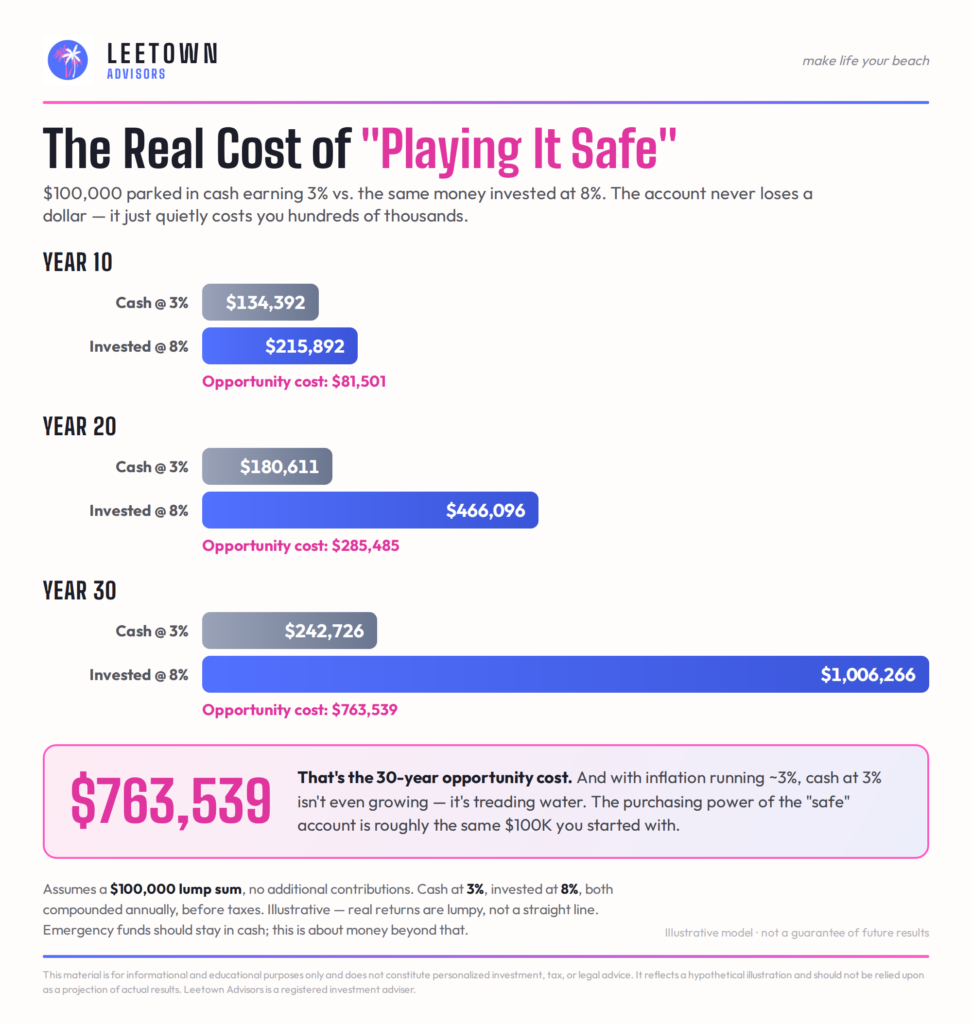
- Take $100k sitting in cash beyond your actual needs. At 3%, in 30 years it’s about $243k. Invested at 8%, it’s about $1 million. Same starting dollar, same 30 years — roughly $760k of difference. That’s not a rounding error. That’s a paid-off house.
- And it gets worse the longer you save. Invest $1k a month and, in the early years, your balance is mostly just the money you put in. Give it 20 or 30 years and the growth dwarfs the contributions — the money your money made becomes the whole damn show. Cash never gets there. In cash, your basis is basically the balance, forever. You did all the work; your dollars did none.

A True Story
- A prospective client came to me having saved $550k over 30 years. All cash. Thirty years of genuine discipline — roughly $1500 a month, every month, without fail. That’s the hard part, and they nailed it.
- Invested in boring index funds, that same discipline would be worth roughly $2.3 million. Instead of $500k. Same sacrifice, same paychecks, same 30 years — almost $2 million of retirement just… evaporated.
- In the real world, that’s a big difference in quality of life.
- With $550k in cash earning 3%, they can spend $50k/year, with no cost of living adjustments, and they will run out of money in 13 years
- With $2.3m invested appropriately, they can spend $100k/year, give themselves raises each year for as long as they live, and still have plenty left over to pass on to their kids.
- The difference isn’t just in the numbers, it is in what you actually do with the damn money. Remember, money is a means to an end, not an end in itself. Travel, your grandkid’s college, your spouse’s healthcare, your church’s fundraiser for the homeless. I don’t care what your priorities are, but I know you have them, and most of them cost money. I just want to make sure you don’t have to make hard choices because of money.
The Fix
- Keep 1–3 months of spending in cash, plus any big expenses on the near horizon. That’s the emergency fund and the known bills. That cash is doing its actual job. Not one dollar more.
- Invest the rest based on when you’ll need it. Money you’ll touch within 5 years: conservative. Anything beyond that: aggressive. Match the assets to the liabilities — you’ve heard me say it before, and I’ll die on that hill.
- Then let the boring index funds do the heavy lifting. Your only job is to not interrupt them.
Here’s the honest truth: the cash never made you safer. It made you feel safer, and that feeling cost my prospective client $1.8m. Real security isn’t a big pile of dollars slowly dissolving — it’s assets that outrun inflation long enough to fund the life you actually want. Keep the emergency fund. Respect the feeling. Then put the rest of your money to work and go enjoy yourself, because that’s the whole point: Make Life Your Beach.
Sitting on a pile of cash and not sure how much is too much? Reply to this email, or hit the button below to grab a time.
Resources
How To Avoid The Middle Class Tax Bomb
Make Life Your Beach
Memento Mori
Write Your Own Eulogy